Reliability through experience



Renewable Fuels
Renewable
Fuels
The transition to Renewable Fuels is increasing demand for biomass and biogenic carbon. Residues, by-products and biogenic CO₂ are evolving from low-value side streams into strategic feedstocks for bio-methanol, e-methanol and SAF.
Renewable Fuels benefit from some of the strongest policy support in any decarbonisation market, while fuel price volatility and energy security concerns are further accelerating demand for locally produced fuel alternatives.
Project bankability however depends on strong collaboration between the customer, technology providers and integrator, backed by an investor-grade cost estimate.
De Smet Engineers & Contractors (DSEC) is the ideal partner and integrator for commercial and demonstration Renewable Fuels plants, thanks to its:
- Expertise in biogenic feedstock handling, pre-treatment, and gas purification, distillation, heat integration and Balance of Plant.
- Integrated engineering, design, and project delivery
- Strong process and interface management
- Flexible and transparent execution
- Proven FOAK project experience
DSEC supports project developers, technology providers and industrial producers throughout this journey, from early feasibility studies (FEL1/FEL2) through FEED to EPCM or EPC execution.

Renewable
Fuels
Renewable Fuels
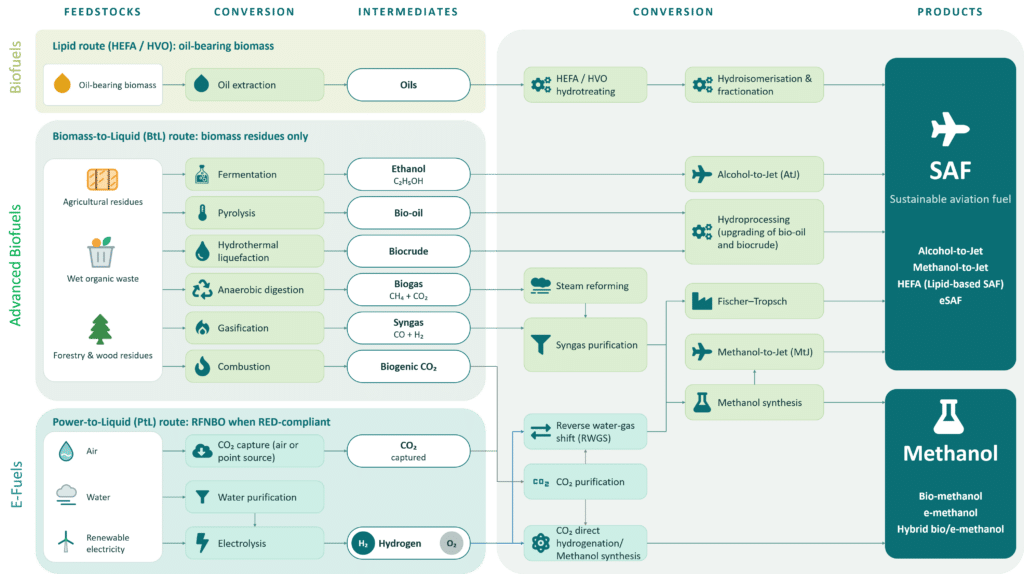
Renewable Fuels include Renewable Methanol (bio- and e-methanol) and Sustainable Aviation Fuel (SAF).
Apart from HEFA-based SAF, which starts from waste oils and fats, both methanol and SAF can be produced via two main routes, which can also be combined in a hybrid setting.
In the Biomass-to-Liquid (BtL) route, organic waste and residues such as forestry and agricultural residues, municipal solid waste and biogas are converted into ethanol, syngas or biogas, and then further into liquid fuels. Because it uses residues, this route produces advanced biofuels.
In the Power-to-Liquid (PtL) route, renewable electricity splits water into hydrogen in an electrolyser. The hydrogen is combined with CO₂ from biogenic sources such as fermentation, biogas or biomass combustion, or captured from the air, and converted into liquid e-fuels. Where the hydrogen meets the RED III criteria, the result qualifies as an RFNBO.